Introduction: The Shift to Human-Centric Risk
Insider threat has evolved into one of the most complex challenges in modern security, not because systems have become weaker, but because the human element has become more exposed. Traditional cybersecurity has focused heavily on protecting infrastructure—networks, endpoints, and access controls—yet the origins of insider risk rarely begin within those systems. They begin with people: their motivations, pressures, beliefs, and behaviours. Increasingly, these factors are visible long before any technical indicator is triggered, often expressed openly across social media platforms. This is where social media profiling, supported by Social Media Intelligence (SOCMINT), becomes a critical capability in identifying and understanding insider threat.
Moving Beyond the Perimeter: From System Risk to Human Risk
To understand the value of social media profiling, one must move beyond the idea of cybersecurity as purely a technical discipline. Insider threat is fundamentally a human risk problem. By the time unusual system activity is detected, the underlying drivers—stress, grievance, financial pressure, or ideological alignment—have often been developing over an extended period. Social media provides a unique window into this pre-incident phase. It offers insight into how individuals think, how they feel, and how their circumstances are evolving in real time. This enables organizations to shift from reacting to incidents toward anticipating risk before it materializes.
What Social Media Profiling Really Involves
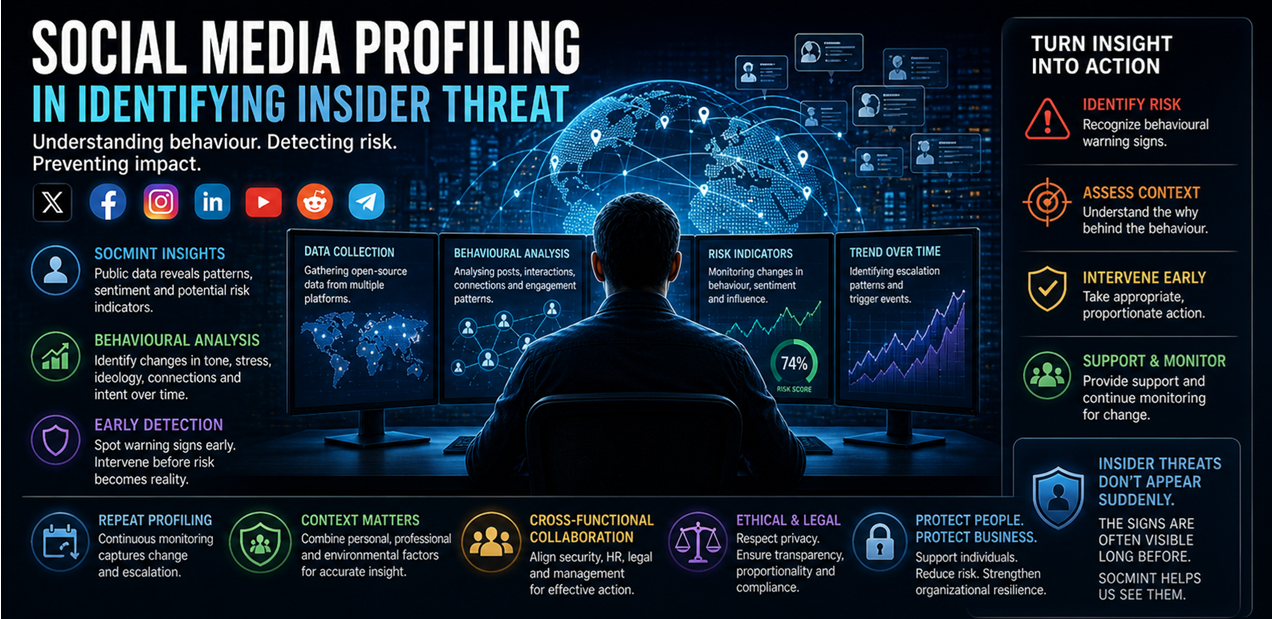
Effective social media profiling is far more than casually reviewing posts or scanning for keywords. At a professional level, it is a structured analytical process that combines behavioural science, contextual understanding, and temporal analysis. It begins with aggregating an individual’s digital footprint across platforms, including their posts, interactions, networks, and engagement patterns. From there, a behavioural baseline is established—what is normal for that individual in terms of tone, frequency, topics, and interaction style.
This baseline is critical, as risk is rarely defined by behaviour itself, but by deviation from that behaviour. Context is then layered in, taking into account career stage, personal circumstances, and external influences that may shape how and why behaviour is changing. Finally, behaviour is mapped over time, enabling analysts to identify trends, escalation, and trigger events. The result is not just data, but behavioural intelligence.
Behavioural Indicators: Understanding Signal vs Noise
One of the most important aspects of social media profiling is the ability to distinguish between noise and meaningful signal. Human behaviour is inherently variable, and isolated expressions—such as a single negative post or moment of frustration—rarely indicate risk. The real value lies in identifying patterns over time. Sustained emotional shifts, such as increasing frustration or resentment, may signal deeper dissatisfaction. Indicators of financial stress, including discussions of debt or visible lifestyle inconsistencies, can point to vulnerability.
Ideological shifts toward more polarized or grievance-based narratives may indicate changing motivations or external influence. Workplace-related expressions, such as public criticism of leadership or disclosure of internal frustrations, can reveal erosion of trust or loyalty. Changes in social networks, including withdrawal from established circles or rapid alignment with new groups, can further reinforce emerging risk patterns. Individually, these signals are ambiguous. Together, they form a coherent and actionable picture.
The Critical Role of Repeat Profiling
A major limitation in many insider threat programs is the reliance on static, once-off assessments—typically conducted during pre-employment screening or after an incident. This approach assumes that individuals remain constant, when in reality, human behaviour is dynamic and influenced by evolving circumstances.
Repeat profiling addresses this gap by capturing behavioural change over time. It allows organizations to detect subtle behavioural drift, where incremental changes accumulate into meaningful risk. It enables the identification of escalation pathways, where frustration develops into grievance and eventually rationalization. It also helps distinguish between anomalies and consistent patterns, ensuring that decisions are based on sustained behaviour rather than isolated events.
Importantly, repeat profiling aligns analysis with real-world triggers such as job changes, financial stress, personal crises, or professional setbacks. These events can significantly alter an individual’s risk profile in a short period. Without ongoing assessment, such shifts remain invisible. With it, organizations gain a dynamic and evolving understanding of risk.
From Insight to Prevention
When applied effectively, social media profiling enables a shift from detection to prevention. Rather than responding after an incident has occurred, organizations can identify at-risk individuals early and take appropriate action. This does not necessarily mean punitive measures. In many cases, the appropriate response may involve support—through management engagement, wellness interventions, or temporary adjustments to access and responsibilities.
This reflects a critical shift in mindset. Insider threat is not always driven by malicious intent; it is often rooted in vulnerability. Recognizing and addressing that vulnerability not only reduces risk but also strengthens organizational resilience.
Ethical, Legal, and Trust Considerations
The use of social media profiling must be handled with care. Without clear governance, it can quickly become intrusive and undermine trust. Transparency is essential, ensuring that individuals understand what is being monitored and for what purpose. The scope of profiling must be proportionate and focused on legitimate risk indicators, avoiding unnecessary intrusion into personal privacy.
Organizations must also ensure full compliance with legal and regulatory frameworks governing data protection and employee rights. Ultimately, the success of any insider threat program depends on trust. Without it, even the most sophisticated capabilities will fail. When implemented responsibly, however, social media profiling becomes a tool for protection rather than surveillance.
Limitations and the Need for Analytical Discipline
Despite its value, social media profiling is not without limitations. Digital behaviour does not always reflect reality, and context can be easily misinterpreted. Sarcasm, cultural nuances, and incomplete information can lead to false conclusions. Additionally, not all activity is visible, particularly on private or encrypted platforms.
For this reason, social media profiling should never operate in isolation. It must be integrated with other data sources and supported by skilled human analysis. Analytical discipline, corroboration, and context are essential to ensure that insights are accurate and actionable.
Conclusion: Seeing the Pattern Before the Incident
Insider threat is not a single event, but a process—one that unfolds over time, shaped by human behaviour and external influences. Social media profiling provides a powerful lens into that process, offering visibility into patterns that would otherwise remain unseen.
When applied systematically, ethically, and repeatedly, it enables organizations to detect vulnerability before it becomes exploitation, understand intent before it becomes action, and intervene before damage occurs. In a world where technical defenses are increasingly advanced, the true differentiator lies not only in what systems can detect, but in how well we understand the people behind them.
By Laurie James