
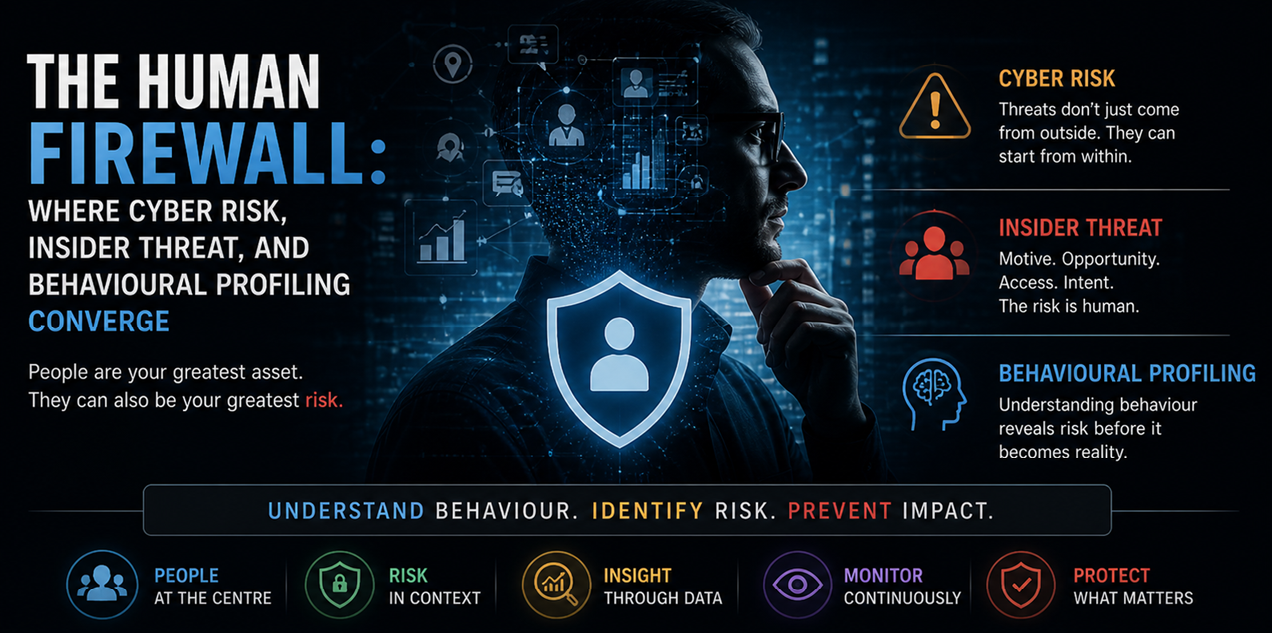
Introduction: The Human Element in Modern Cybersecurity
For decades, cybersecurity has been framed as a technological arms race. Organizations invested heavily in firewalls, endpoint detection platforms, intrusion prevention systems, encryption, and increasingly sophisticated Zero Trust architectures. Security strategies were built around defending digital perimeters, hardening infrastructure, and preventing unauthorized access. Yet despite this unprecedented investment in technology, breaches continue to occur at an alarming rate.
The reason is increasingly clear: the most persistent vulnerability in any organization has never been purely technical. It is human.
Modern threat actors understand that while systems may be hardened, people remain susceptible to pressure, manipulation, fatigue, emotional influence, and error. As a result, the battlefield of cybersecurity has shifted away from purely technical exploitation and toward human exploitation. Cyber risk is no longer just about malicious code or vulnerable systems; it is about behaviour, psychology, trust, and decision-making.
At the intersection of cyber risk, insider threat, and behavioural profiling lies one of the most important realities in modern security:
The greatest threat to a system is often the individual operating within it.
This convergence represents a profound transformation in how organizations must think about risk, security, and resilience.
The Evolution of Cyber Risk: From External Threats to Human Vulnerabilities
Historically, cyber risk was viewed through a relatively straightforward lens. Threats were external. Attackers attempted to breach networks from outside the organization, and security teams focused on defending the perimeter.
This model no longer reflects reality.
Modern organizations operate in highly connected digital ecosystems involving:
- Remote workforces
- Cloud environments
- Third-party vendors
- Mobile devices
- Hybrid infrastructures
- Constant digital communication
In these environments, the perimeter has effectively dissolved.
At the same time, technical security controls have matured significantly. Organizations are now better equipped to detect malware, monitor suspicious network activity, and prevent many forms of traditional intrusion. Threat actors have adapted accordingly. Rather than attacking systems directly, they increasingly target the individuals who operate those systems.
This shift is evident in the rise of:
- Social engineering attacks
- Business email compromise (BEC)
- Credential theft
- Phishing and spear-phishing campaigns
- Insider-enabled breaches
- Psychological manipulation tactics
The modern attacker understands a critical principle: humans can often bypass controls that technology cannot.
An employee can unknowingly approve a fraudulent payment, disclose sensitive information, click a malicious link, or provide access to a threat actor. In many cases, they can do so while technically operating within their authorized permissions.
This reality has fundamentally changed the nature of cyber risk.
Cybersecurity is no longer solely about protecting infrastructure. It is about understanding and managing human behaviour within digital environments.
Insider Threat: A Broader and More Complex Reality
Insider threat is often misunderstood because it is commonly associated only with malicious insiders—disgruntled employees, corporate spies, or individuals intentionally seeking to harm the organization.
While malicious insiders certainly exist, this represents only a small portion of the insider threat landscape.
The modern insider threat ecosystem is significantly more complex and includes multiple categories of risk.
Negligent Insiders
Negligent insiders are individuals who unintentionally expose the organization to risk through poor security practices, lack of awareness, or human error.
Examples include:
- Clicking phishing links
- Using weak passwords
- Mishandling sensitive information
- Circumventing security controls for convenience
- Sharing credentials or devices improperly
These individuals often have no malicious intent whatsoever. However, their behaviour can create vulnerabilities that external threat actors exploit with devastating consequences.
In many organizations, negligence remains one of the largest contributors to cyber incidents.
Compromised Insiders
A compromised insider is not malicious but has become an unwilling vector for threat activity.
This may occur through:
- Credential theft
- Malware infections
- Social engineering manipulation
- Account hijacking
- Device compromise
In these cases, attackers operate through legitimate user access, making detection significantly more difficult. Because activity appears to originate from trusted users, traditional security controls may fail to recognize the threat.
This highlights an important shift in cybersecurity:
Identity has become the new attack surface.
Emotionally or Psychologically Vulnerable Individuals
One of the most misunderstood aspects of insider threat is the role of human vulnerability. Organizations often focus heavily on technical indicators—unauthorized access attempts, suspicious downloads, unusual network activity, or policy violations—while overlooking the psychological and emotional conditions that frequently precede those behaviours. Yet in many cases, insider risk begins not with malicious intent, but with a gradual deterioration in an individual’s emotional, psychological, or situational stability.
Human beings do not operate in isolation from their circumstances. Stress, burnout, financial pressure, workplace conflict, emotional instability, personal trauma, relationship breakdowns, substance abuse, fatigue, and feelings of isolation all influence judgement, decision-making, and behavioural control. These pressures may appear unrelated to cybersecurity on the surface, but they can significantly increase an individual’s susceptibility to risk.
In high-pressure working environments, chronic stress and burnout are becoming increasingly common. Employees operating under sustained pressure often experience cognitive fatigue, reduced concentration, emotional exhaustion, and impaired decision-making. In cybersecurity terms, this can translate into shortcuts, overlooked warnings, policy non-compliance, or increased susceptibility to social engineering attacks. Individuals under stress are less likely to critically assess suspicious emails, question unusual requests, or follow established security procedures consistently. What may appear externally as negligence is often rooted in overload and mental fatigue.
Financial pressure represents another major vulnerability factor. Individuals facing debt, financial insecurity, gambling issues, lifestyle pressures, or sudden economic hardship may experience heightened emotional strain and desperation. This does not automatically create malicious intent, but it can increase the likelihood of rationalizing behaviour that would previously have been unacceptable. Financial distress has historically been one of the most significant motivators in cases involving fraud, intellectual property theft, unauthorized data access, and recruitment by external threat actors.
Similarly, workplace conflict and perceived injustice can profoundly influence behaviour. Employees who feel marginalized, overlooked, unfairly treated, humiliated, or professionally trapped may begin developing grievance narratives. These narratives are psychologically important because they often form the foundation for behavioural rationalization. Individuals may begin justifying policy violations or harmful actions by convincing themselves that the organization “deserves it,” that they are “recovering what they are owed,” or that leadership has failed them. This process rarely occurs instantly. It develops gradually through emotional reinforcement over time.
Emotional instability and personal crises can further amplify vulnerability. Divorce, bereavement, family conflict, mental health struggles, addiction, social isolation, or traumatic experiences can significantly alter behavioural patterns and emotional regulation. Individuals experiencing emotional instability may become more impulsive, reactive, withdrawn, or susceptible to external influence. Their focus shifts from organizational responsibility toward personal survival and emotional coping. In these conditions, security awareness often deteriorates rapidly.
One of the most critical realities in insider threat analysis is that adversaries actively seek out vulnerability. Threat actors understand human psychology exceptionally well. Social engineering campaigns are specifically designed to exploit trust, fear, urgency, loneliness, greed, curiosity, or emotional need. Coercion and recruitment efforts frequently target individuals already under pressure because vulnerable individuals are easier to manipulate.
This manipulation may occur gradually. An employee experiencing financial distress may initially accept seemingly harmless requests or small incentives. Over time, boundaries shift. Behaviour becomes normalized. Rationalization deepens. What begins as minor policy violations can escalate into serious compromise or intentional malicious activity.
Importantly, insider threat rarely manifests as a sudden transformation from trusted employee to malicious actor. The process is usually progressive and behavioural in nature. Small indicators often emerge long before any operational incident occurs. These indicators may include:
- Changes in communication tone or emotional expression
- Increased negativity or grievance-focused behaviour
- Withdrawal from colleagues or social interaction
- Declining work performance or engagement
- Unusual working hours or behavioural irregularities
- Increased secrecy or defensiveness
- Escalating frustration with organizational policies or leadership
Individually, these behaviours may appear insignificant or unrelated to security. However, when viewed collectively and over time, they can reveal meaningful patterns of elevated risk.
This is where behavioural profiling becomes critically important.
Behavioural profiling provides organizations with the ability to identify behavioural drift and emerging risk indicators before they escalate into incidents. Rather than focusing solely on isolated technical events, behavioural profiling seeks to understand context, change, and patterns over time. It allows organizations to establish behavioural baselines and recognize deviations that may signal stress, coercion, disengagement, or vulnerability.
The goal is not surveillance or punishment. Effective behavioural profiling is fundamentally about early awareness and intervention. In many cases, the appropriate response to elevated risk is not disciplinary action, but support. An employee showing signs of burnout may require workload adjustments or wellness support. An individual under emotional strain may need managerial engagement or assistance. Someone displaying escalating frustration may require intervention before grievance solidifies into intent.
This represents a major shift in cybersecurity thinking. Traditional security models are reactive—they respond after an event occurs. Behavioural profiling enables proactive risk management by identifying the human conditions that often precede compromise.
As organizations continue investing in advanced technologies, artificial intelligence, and automated security controls, the human dimension of risk will become increasingly important. Technology can identify suspicious actions, but understanding why those actions occur requires behavioural insight.
Ultimately, insider threat is not only a cybersecurity issue. It is a human behaviour issue.
And in many cases, the greatest vulnerabilities are not found in systems.
They are found in unrecognized human pressure, emotional strain, and behavioural change..
Behavioural Profiling: Understanding Risk Through Human Patterns
Behavioural profiling in cybersecurity is not about invasive surveillance or simplistic monitoring. At its core, it is the structured observation and analysis of behavioural patterns to identify meaningful deviations, anomalies, and indicators of elevated risk.
Traditional cybersecurity monitoring focuses primarily on actions:
- Login attempts
- File access
- Network activity
- Data transfers
Behavioural profiling seeks to go deeper.
It focuses on:
- Context
- Intent
- Behavioural change over time
- Emotional and psychological indicators
- Patterns rather than isolated events
This represents a shift from purely technical monitoring to behavioural intelligence.
Behavioural Drift and Escalation Pathways
One of the most important concepts in insider threat analysis is behavioural drift.
Individuals rarely transition instantly from trusted employees to malicious actors. Risk typically develops progressively through stages.
This may include:
- Emotional dissatisfaction
- Grievance formation
- Disengagement
- Rationalization of behaviour
- Policy violations
- Escalation toward malicious action
This progression is often subtle and difficult to detect through technical monitoring alone.
Behavioural profiling helps organizations identify these escalation pathways early, before they manifest as operational incidents.
This is why repeat profiling and continuous behavioural assessment are essential. Human behaviour is dynamic. Circumstances change. Stress accumulates. Motivations evolve.
Static assessments are insufficient in environments where risk is constantly shifting.
The Convergence of Cybersecurity, Psychology, and Behavioural Science
he convergence of cyber risk, insider threat, and behavioural profiling represents one of the most important paradigm shifts in modern security.
Cybersecurity is no longer purely technical.
It now intersects with:
- Behavioural science
- Psychology
- Organizational culture
- Human performance
- Emotional resilience
- Social dynamics
Organizations are increasingly recognizing that understanding human behaviour is as important as understanding system vulnerabilities.
This convergence enables organizations to:
- Identify risk before incidents occur
- Detect behavioural anomalies early
- Understand contextual drivers of risk
- Improve insider threat prevention
- Build stronger organizational resilience
In this model, cybersecurity evolves from reactive defense into proactive risk management.
The Human Firewall: Awareness as a Security Layer
he concept of the “human firewall” reflects the understanding that employees are not merely vulnerabilities to control, but active participants in organizational defense.
A strong human firewall is built through:
- Security awareness
- Behavioural understanding
- Psychological resilience
- Organizational trust
- Culture and communication
When employees feel supported, engaged, and aware, they become significantly more resistant to manipulation and exploitation.
Conversely, toxic workplace environments, chronic stress, and poor organizational culture often amplify insider risk.
This highlights an important truth:
Insider threat is not solely a security issue. It is also a leadership and culture issue.
Ethical Considerations and the Balance Between Security and Trust
The use of behavioural profiling introduces significant ethical and legal considerations.
Without proper governance, behavioural monitoring can become intrusive, excessive, and damaging to organizational trust.
Organizations must therefore establish clear principles around:
- Transparency
- Purpose limitation
- Proportionality
- Privacy protection
- Data governance
- Legal compliance
Employees should understand:
- What is being monitored
- Why it is monitored
- How information is used
- What protections exist
Behavioural profiling should never be used to criminalize individuals or create cultures of fear. Its purpose is risk mitigation, early intervention, and organizational protection.
When implemented responsibly, behavioural profiling supports both the organization and the employee.
The Future of Cybersecurity Is Human-Centric
The future of cybersecurity will increasingly revolve around understanding human behaviour.
As artificial intelligence, automation, and digital interconnectivity continue to evolve, purely technical controls will no longer be sufficient. Organizations must develop the ability to:
- Understand behavioural context
- Detect emotional and psychological risk indicators
- Monitor behavioural change over time
- Integrate human intelligence into security frameworks
The strongest security posture will not belong solely to organizations with the most advanced technology.
It will belong to organizations that best understand the relationship between people, behaviour, and risk.
Conclusion: Understanding the Person Behind the System
Systems do not make decisions. People do.
In a world of increasing digital complexity, the strongest firewall is not merely technological.
It is behavioural understanding, awareness, and trust.
Because the future of cybersecurity is not only technical.
It is profoundly human.
By Laurie James