
Introduction
Modern executives operate in a world of relentless pressure. Between constant decision-making, crisis management, financial responsibility, staff oversight, and the expectation to consistently perform at a high level, many leaders spend years functioning in a near-constant state of stress. While leadership positions often come with prestige and influence, they also carry significant psychological and emotional burdens that are frequently hidden beneath professionalism and performance.
In recent years, many executives have begun searching for more meaningful and effective ways to manage stress and restore balance. Traditional methods such as executive coaching, mindfulness, psychotherapy, and wellness retreats remain valuable, but there is growing interest in experiential approaches that address not only the mind, but also the nervous system, emotional regulation, and authentic human connection. One of the most powerful emerging approaches is Equine-Assisted Therapy, also known as Equine-Assisted Learning or Equine-Assisted Psychotherapy.
Equine-assisted therapy involves structured interactions between humans and horses under the guidance of trained facilitators. While it may initially appear unconventional in a corporate or executive environment, the results are increasingly drawing attention from leadership coaches, psychologists, wellness professionals, and organizational development experts. Horses possess an extraordinary sensitivity to human emotion, body language, stress, and non-verbal communication. They respond honestly and immediately to emotional states, making them remarkably effective partners in emotional awareness and leadership development.
For executives who spend much of their lives in environments driven by performance, competition, and constant stimulation, working with horses can become a deeply transformative experience. Equine-assisted therapy provides a space where stress patterns, communication habits, emotional responses, and leadership behaviors become visible in real time. It offers leaders the opportunity to reconnect with calmness, presence, resilience, and authentic leadership in ways that traditional approaches sometimes struggle to achieve.
Understanding the Reality of Executive Stress
Executive stress is often misunderstood. Many people assume that stress at leadership level is simply about long hours or demanding schedules. In reality, executive stress is far more complex. Leaders are expected to make high-stakes decisions, manage uncertainty, navigate interpersonal conflict, and carry organizational responsibility while maintaining composure and confidence. Over time, this creates cumulative emotional and physiological strain.
Many executives function in environments where vulnerability is discouraged and emotional suppression becomes normalized. The pressure to always appear capable and in control often causes leaders to disconnect from their own emotional state. This can lead to chronic anxiety, emotional exhaustion, burnout, irritability, sleep disruption, reduced empathy, decision fatigue, and difficulty regulating stress under pressure.
One of the most dangerous aspects of executive stress is that it often develops gradually. High performers become accustomed to operating under pressure and may not recognize the extent to which chronic stress is affecting their thinking, emotional regulation, relationships, and physical health. Over time, this state of prolonged activation can negatively impact leadership effectiveness, workplace culture, strategic thinking, and overall well-being.
Equine-assisted therapy approaches stress differently from traditional cognitive interventions. Instead of focusing only on talking about stress intellectually, equine work creates an embodied experience where executives become aware of how stress manifests physically, emotionally, and behaviorally in real time. This awareness often becomes the first step toward meaningful change.
Why Horses Are So Effective in Stress Management
Horses are uniquely suited to emotional and behavioral work because they are highly sensitive prey animals that rely on reading subtle environmental and emotional cues for survival. Unlike humans, horses do not respond to status, titles, job positions, or rehearsed communication. They respond to authenticity.
This is one of the reasons equine-assisted therapy can be so powerful for executives. Many leaders become highly skilled at managing perception in corporate environments. They may project calmness externally while internally experiencing anxiety, frustration, or emotional overload. Horses, however, react to what is genuinely happening beneath the surface rather than what is verbally presented.
During equine-assisted sessions, executives often discover that horses respond differently depending on the leader’s emotional state, clarity, confidence, or level of tension. If an individual is internally unsettled, impatient, emotionally reactive, or disconnected, the horse often mirrors that instability. Conversely, when the person becomes calm, grounded, focused, and emotionally regulated, the horse responds positively.
This creates a powerful and immediate feedback system that allows executives to observe how their emotional state influences communication, relationships, and leadership outcomes. Many leaders describe this experience as profoundly eye-opening because it reveals aspects of themselves that are often hidden in traditional workplace environments
The Neuroscience of Stress Reduction
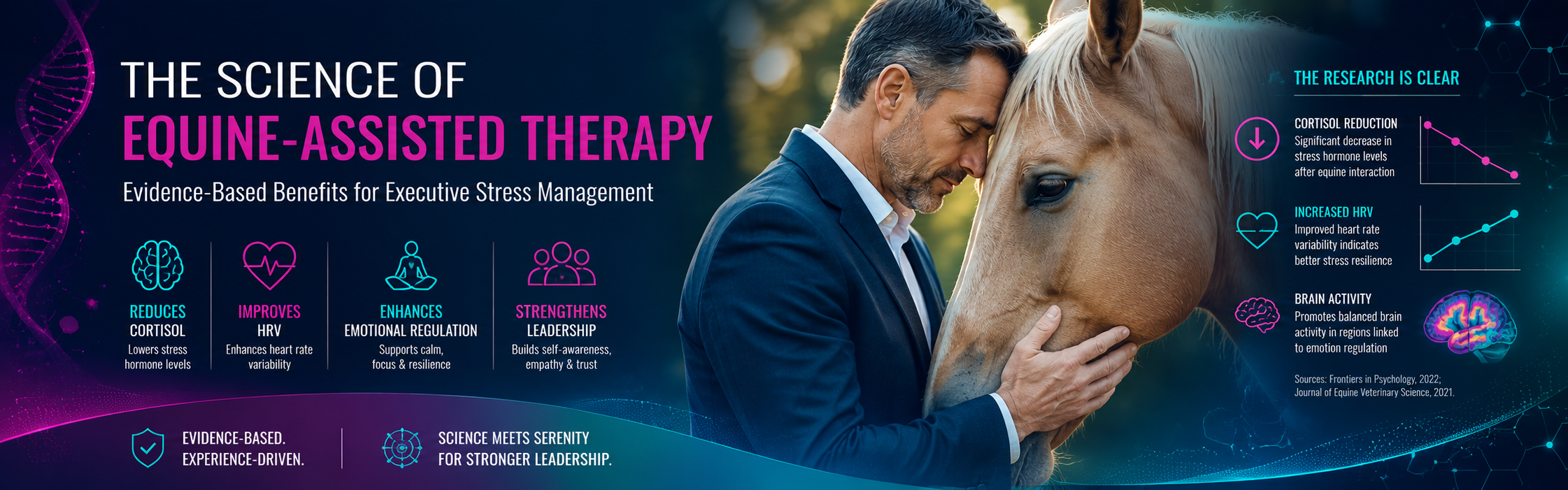
One of the most significant benefits of equine-assisted therapy lies in its ability to regulate the nervous system. Chronic executive stress keeps the body in an ongoing state of sympathetic nervous system activation, commonly known as the fight-or-flight response. This state increases cortisol, adrenaline, muscular tension, vigilance, and emotional reactivity.
Over time, chronic activation can impair cognitive performance, emotional regulation, immune function, and overall mental health. Executives operating under prolonged stress often struggle to switch off mentally, even outside the workplace.
Equine-assisted therapy naturally encourages nervous system regulation. The physical presence of horses, combined with outdoor environments, rhythmic movement, mindful interaction, and present-moment awareness, helps shift the body into a calmer physiological state. Many executives report feeling mentally quieter, emotionally calmer, and more grounded after spending time with horses.
Research into equine-assisted interventions has explored changes in cortisol levels, heart rate variability, emotional regulation, and stress responses. Emerging evidence suggests that equine interaction may contribute to reduced physiological stress and improved emotional balance. For many executives, this becomes one of the first experiences in years where they feel genuinely present rather than mentally consumed by work-related demands.
Emotional Intelligence and Leadership Awareness
Emotional intelligence has become one of the most important predictors of leadership success in modern organizations. Leaders who possess strong emotional awareness, empathy, communication skills, and emotional regulation are generally more effective at building trust, managing teams, navigating conflict, and creating psychologically safe workplaces.
Equine-assisted therapy provides an unusually powerful environment for developing emotional intelligence because horses are exceptionally responsive to emotional congruence and non-verbal communication. During interactions with horses, executives often become aware of how subtle changes in emotion, intention, posture, tension, and communication influence outcomes.
A leader who approaches a horse with frustration or control-oriented behavior may experience resistance. A leader who communicates with calmness, clarity, and confidence often experiences cooperation and trust from the horse. These experiences create valuable insight into leadership style and interpersonal dynamics.
Many executives discover that leadership is not simply about authority or technical competence. Instead, effective leadership depends heavily on emotional regulation, trust, presence, consistency, and authenticity. Equine-assisted learning helps leaders experience these principles directly rather than merely discussing them theoretically.
Burnout, Emotional Exhaustion, and Recovery
Executive burnout has become increasingly common across industries. Burnout is not simply physical fatigue. It is a state of emotional depletion, psychological disengagement, reduced motivation, and diminished resilience that affects both personal well-being and professional performance.
Many executives become trapped in cycles of constant productivity, digital overstimulation, and emotional suppression. Over time, they lose connection with themselves, their values, and the sense of meaning that initially motivated them.
Equine-assisted therapy offers something fundamentally different from many traditional executive interventions. The experience often slows individuals down enough to reconnect with emotional awareness, presence, and internal balance. Horses require calmness and authentic engagement, making it difficult for executives to remain mentally distracted or emotionally disconnected during sessions.
For many leaders, this becomes a rare opportunity to step outside high-pressure environments and experience stillness, reflection, and emotional decompression. Executives frequently report feeling emotionally lighter, mentally clearer, and more connected to themselves after equine-assisted sessions. This reconnection can play an important role in burnout recovery and long-term resilience.
Communication, Presence, and Non-Verbal Leadership
One of the most profound lessons executives learn through equine-assisted therapy is the importance of non-verbal communication. Leadership communication extends far beyond words. Tone, posture, emotional energy, tension, breathing patterns, and overall presence all influence how leaders are perceived by others.
Horses are highly attuned to these non-verbal signals. They react immediately to emotional inconsistency, tension, aggression, uncertainty, or emotional disconnection. This makes executives far more aware of how they communicate under stress.
Many leaders begin to recognize patterns they were previously unaware of, such as impatience, emotional rigidity, excessive control, or anxiety-driven communication. Through guided exercises, executives learn how calmness, emotional clarity, and grounded presence create more effective interactions.
This awareness often translates directly into workplace leadership. Executives who improve emotional regulation and communication presence frequently become more effective during negotiations, crisis situations, difficult conversations, and team management.
Trust, Vulnerability, and Authentic Leadership
High-performance corporate cultures often encourage emotional armor. Many executives feel pressure to maintain authority, confidence, and composure at all times. While professionalism is important, chronic emotional suppression can create disconnection, isolation, and reduced authenticity.
Equine-assisted therapy creates a space where authenticity matters more than performance. Horses do not respond to professional status or corporate image. They respond to emotional honesty and congruence.
This can be deeply transformative for executives who have spent years operating behind professional identities. Many leaders discover that vulnerability, emotional awareness, and authenticity are not weaknesses, but essential components of trust-based leadership.
As executives become more comfortable with emotional awareness and authentic communication, they often develop stronger interpersonal relationships, healthier leadership styles, and improved workplace trust.
The Future of Executive Wellness
As workplace stress, burnout, and leadership fatigue continue to rise globally, organizations are increasingly recognizing that executive wellness is not a luxury — it is a strategic necessity. Sustainable leadership requires more than productivity and technical competence. It requires emotional resilience, psychological regulation, adaptability, and authentic human connection.
Equine-assisted therapy represents a growing shift toward more human-centered approaches to leadership development and stress management. It combines emotional insight, experiential learning, nervous system regulation, mindfulness, and leadership awareness in a way that traditional interventions often cannot fully replicate.
For executives operating in high-pressure environments, the experience of working with horses can become far more than a wellness activity. It can become a profound lesson in presence, calmness, emotional intelligence, and authentic leadership.
In a world increasingly dominated by technology, constant connectivity, and performance pressure, the simple act of standing beside a horse and learning to regulate one’s own emotional state may offer one of the most valuable leadership lessons of all.
True leadership does not come from control alone.
It comes from awareness, balance, trust, and the ability to remain calm and authentic under pressure.
Book Your session with Laurie today
By Laurie James